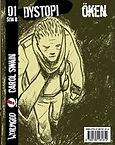
"In the summer of 1987, London’s Institute of Contemporary Art was showing Comic Iconoclasm, a skewed survey of ‘high’ art inspired by ‘lowly’ comics. On September 12th, Carol joined a workshop there organised by Escape, the magazine I co-edited. Rather than presuming to teach anyone, the object was to get everybody to create a page for a comic to be produced in two hours on the ICA’s photocopier. Carol came up with six silent panels in which a young man finds blissful oblivion in his can of beer, echoed as the city around him distorts and wobbles in sympathy. Whether this, perhaps her first strip, convinced her to persevere with them, she soon found that comics were her ideal medium. She began composing each panel both as a painting and a movie shot. She switched to stark, textural charcoal, in a style that French BD critics have termed ‘ligne grasse’, literally the ‘dirty’ or ‘rough’ line, polar opposite of the overused Tintin-esque ‘ligne clair’ or ‘clear line’ and so much more sensitive and human. She also found her voice, keeping her words to the minimum, using terse dialogue and silences, constantly shifting 'camera' angles and fierce, warped perspectives, to add to the feeling of disorientation. Atmospheric, oblique, darkly humorous, her strips are like glimpses that hint of bigger stories, about the bands and buskers, the skinheads and squats, the London where she lived, and the teen rebels, displaced, disaffected, outsiders, on the road, on the run, in the mythic America we all know from film, novels, paintings and songs. Take the 'Way Out', the exit, that Carol's strips offer and step into the 'way out' (sur)real world that is right there on your doorstep."
- Paul Gravett


"A disquieting meditation on teenage fantasies in the tradition of Heavenly Creatures and The Miracle, Swain's first full-length graphic novel tells the story of Dai, Helen, and Ivan, three friends who believe that the earthquake that rocked their hometown was caused by - yes - a crashlanding UFO, survived only by their temporary headmaster. Are they right, or is the truth even stranger? Swain's brutally honest depiction of small-town life and her powerfully forthright graphic style create a bruising, harrowing masterwork."
- lambiek.net
"Swain's scrupulous composition, textured line, sparing words, preference for the understated, the pictorially unusual, the oddly comical, the suggestion of greater histories, work toward a narrative where the mood is palpable and preeminent."
– The Comics Journal
"Her work is all about those on the fringes, Swain building rich character pieces in her unique artistic style, often at least partly autobiographical, always beautiful, something that looks at the riches to be found in the everyday."
- Dark and Golden
"Carol Swain has one of the most unique visions and compelling styles in comics"
- Time Magazine
"Foodboy is a fierce and touching human story, and for all its finely-observed contemporary backdrop of a post-Thatcher Wales where fragile, vestigial communities cling doggedly to life around the closed pits in the heartbroken valleys, the emotions and loyalties here could be Paleolithic, as old as the weather-chewed landscape itself. Dark and full of life, like soil, Foodboy is a little masterpiece, a perfect example of what modern comics are capable of if only they try."
- Alan Moore (Watchmen, V for Vendetta, From Hell)
"A chilly, satisfying piece of work."
- The Guardian
"Dubbed 'a work of gritty realism' by Booklist contributor Ray Olson, Foodboy focuses on friends Ross and Gareth, who grow up in the impoverished Welsh mining village of Llanparc. As he reaches adulthood, Ross gradually loses his hope and withdraws from society, eventually becoming homeless and increasingly feral. Gareth, who now works at a local hotel kitchen, serves as Ross's only link to the world, regularly walking up into the mountains and calling his friend out to bring him food. Praising Swain's artistic technique in Foodboy, Olson noted that the author/illustrator's "blocky" style "communicat[es] … the desperation of this parable of poverty and disintegration."
- Encyclopedia.com
"Foodboy is drawn in Swain's trademark style of exquisite panel compositions in which the characters and landscapes embody the twin thematic poles of her work - anomie and empathy, pathos and passivity."
- Fantagraphics Books


“Giraffes… is my favorite graphic novel of the year, and it is marinated in a life lived through real rock and roll delivered via stories as wide-open and lung-puncturing as a two minute Ramones rant. One of the best graphic novels of the year, as well as one of the best rock books too."
– Chris Estey, KEXP radio, Seattle
“Giraffes... chronicles the story of Bruce Paley through the summer of love up to the age of punk rock. It's a personal lesson in history, love, redemption and all that other crap we look for in a good story - all that, and it's a lovingly illustrated graphic novel that breathes characterization and intrigue from the first page to the last."
- Thorin Klosowski, westword.com
“Captivatingly illustrated by Paley’s partner Carol Swain in her trademark monochrome line and textures style, we see his highs and lows: life as heroin addict, hookers and Black Panthers, getting by in crappy jobs, following the ever-changing music scene and even the rare brushes with real fame we’ve all experienced: in this case a short, intense friendship with doomed rock star Johnny Thunders. This is a captivating story and a brilliant use of our medium.”
- Win Wiacek
"At some point, this book will probably become a movie, but I suggest you check out the uncensored version with Carol Swain's great artwork, which sets the scene perfectly. It's a miracle Paley survived to tell these anecdotes, but I'm glad he did."
– Whitney Matheson, USA Today
"If you’re a fan of rock’n’roll, if you dig the Beats, if you like grimy tales of excess and the underbelly of success, this is for you."
- Bookmunch
"A triumphant return for the unique talent that is Carol Swain. Gast is an important book by one of our most fascinating creators, a fully mature artist at the height of her powers."
- Tom Murphy, Broken Frontier
“Helen is an amateur bird watcher who lives in a rural community in Wales. When a local farmer tells Helen that a 'rare bird' named Emrys [a cross-dressing farmer] killed himself, she decides to investigate. Her attempt to learn more about Emrys turns into a journey of self-discovery and ultimately a hard-fought reconciliation with the world. Carol Swain’s Gast is the rare kind of contemporary graphic novel critics are conjuring when they exult over the promise of the art form - a philosophically mature vision, uniquely executed by an artist wholly in control of her craft. In Gast, Helen’s inner life is slowly revealed through a mixture of naturalistic detail and phantasmagorical occurrences”.
– Paul Gravett, http://paulgravett.com/profiles/creator/carol_swain
"She’s virtually created her own genre, of which Gast is the best example yet."
- Grahame Johnstone, The Slings and Arrows Graphic Novel Guide
"Gast does what good literary fiction does, it transports you to a specific location, introduces you to specific characters, and takes you to unexpected and very satisfying conclusions; every panel is intentionally composed and framed, every word balloon lean and to the point. In paring down the exposition, the reader is asked to work a bit harder than in the typical graphic novel, and that extra bit of work is part of the pleasure of reading Gast. Few cartoonists ask as much of the reader as Swain, but few provide as many rewards to readers who don’t just passively turn the pages but who slow down and read carefully. Gast is a wonderful piece of work, Carol Swain is the real deal, and Gast is required reading."
- Paul Karasik, The Comics Journal
"A graphic novel of exquisite and accomplished empathy and restraint."
- Sean T. Collins, The Comics Journal


"This career-spanning collection of Swain's short stories is a needed retrospective on an underrated cartoonist. Swain trained as a painter and her stories are distinguished by an accomplished, atmospheric tonal style that delicately shades her carefully observed, heavily stylised characters and landscapes. Her panels feature striking compositions within a strict grid for panel layouts that enables startling transitions keeping the reader off balance."
- Publishers Weekly
"One day we'll finally realize the true importance Carol Swain had and still has in the British independent comics scene."
- Andres Accorsi, 365 Comics por año
"It's impossible not to reference prose literature when talking about Swain. Even her layouts owe something to the literary. While the nine-panel grid is often the cartoonist's crutch, here, in more capable hands, it becomes a structure to be exploited with its innate rhythms, timing and movement becoming like a form of poetry. She often chooses to end on panoramic panels, like rhyming couplets, adding a contemplative coda to the pieces and driving home the emotional punch. She is one of Britain's most unique voices."
- The Comics Journal
"The legendary Carol Swain [is] a hugely important name in UK comics who I had the privilege of interviewing way back in 2014 as part of the Comica Festival."
- Andy Oliver, Broken Frontier
A selection of comics Carol has appeared in